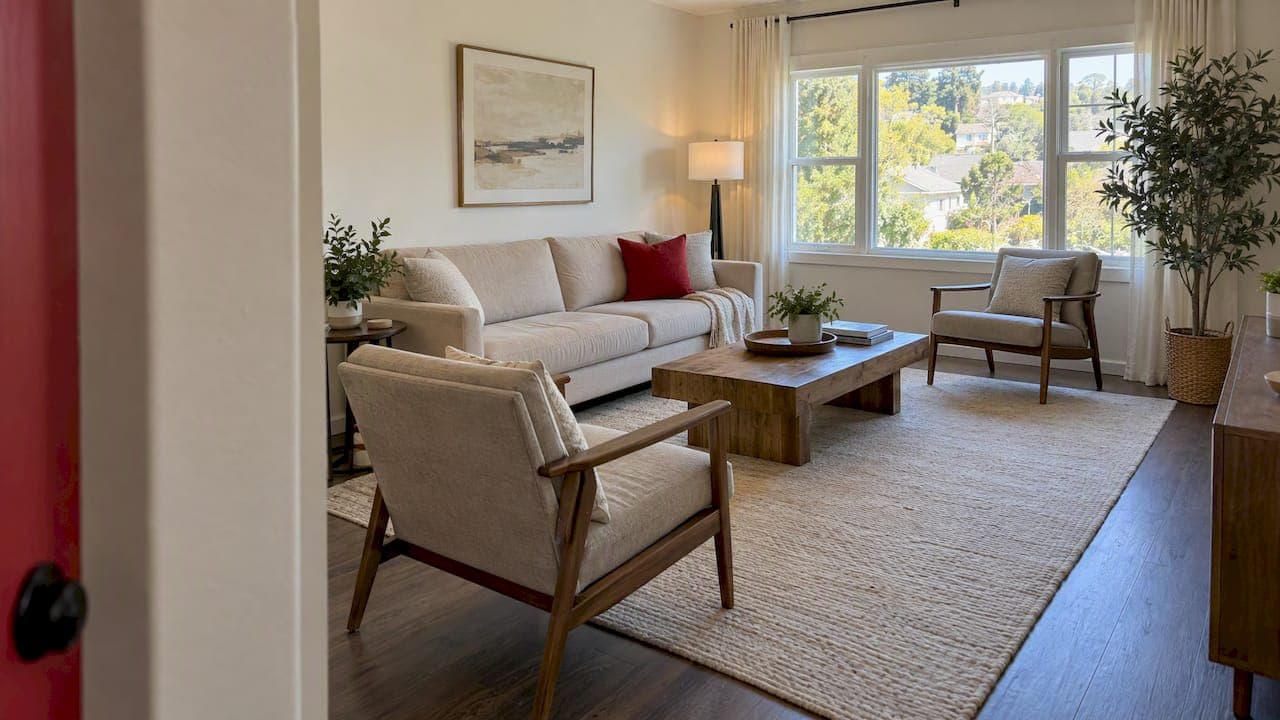
Stage in this order: declutter and depersonalize, deep clean, neutralize paint and odors, then stage the living room, primary bedroom and kitchen first, and finish with curb appeal and showing-day details. Those three rooms matter most to buyers’ agents, and a basic round of staging often costs far less than sellers fear. Below is the full checklist, what it costs, and when virtual staging is enough.
TL;DR
- Work in this order: declutter, clean, repair and repaint, stage key rooms, then curb appeal and showing-day prep.
- Put your effort into the living room, primary bedroom and kitchen. Buyers’ agents ranked them as the most important rooms to stage.
- Staging a home for two to three months typically costs about 1% of its list price. Agents who staged personally reported a median spend of $500.
- Virtual staging is a fast, low-cost option for empty rooms. In California, digitally altered listing photos need disclosure and access to the originals.
- Start three to four weeks before your list date so photos are taken after the work is done, not before.
Table of Contents
- Why staging comes before the photos
- Does staging pay off?
- The timeline: what to do and when
- Step 1: Declutter and depersonalize
- Step 2: Clean like a buyer is inspecting
- Step 3: Repair, repaint and neutralize
- Step 4: Stage the rooms that matter most
- Step 5: Curb appeal and the front entry
- Step 6: Showing-day routine
- Virtual staging vs. traditional staging
- Staging on a tight budget or timeline
- Common staging mistakes
- Our perspective on staging
- Get a listing plan that starts with preparation
- FAQ
- Sources
Why staging comes before the photos
Buyers see your home online first. By the time they walk through the door, they have already decided whether it deserves a showing. Staging is the work that makes the listing photos, the video and the first showing all tell the same story: this is a home I can live in.
The National Association of Realtors puts the goal plainly: staging should highlight a home’s strengths and help buyers picture themselves living there, according to its consumer guide to staging. That is the test for every item below. If a task does not make the house cleaner, brighter, roomier or easier to imagine as theirs, skip it.
Does staging pay off?
The numbers are encouraging, with realistic limits. In the 2025 Profile of Home Staging, 83% of buyers’ agents said staging makes it easier for buyers to visualize a property as their future home. Seventeen percent said it increased the dollar value offered by 1% to 5%. On the sellers’ agent side, 30% reported slight decreases in time on market and 19% reported great decreases.
The same NAR consumer guide notes that more than a quarter of professionals reported offers 1% to 10% higher on staged homes, and about half of sellers’ agents reported staged homes sell faster.
What does it cost? NAR says staging a home for two to three months typically costs about 1% of its list price. In the 2025 profile, the median amount sellers’ agents spent was $1,500 when they used a professional staging service and $500 when they staged the home themselves.
So the honest answer: staging is a modest spend compared with a possible 1% to 5% lift and a shorter marketing period. Most of the checklist below costs time rather than money.

The timeline: what to do and when
A simple schedule keeps you from rushing the last week.
| When | What to do |
|---|---|
| 4 weeks before listing | Walk the house with a critical eye. Make your repair and paint list. Start decluttering and renting storage if needed. |
| 3 weeks before | Finish repairs and repainting. Book carpet cleaning, window washing and any landscaping help. |
| 2 weeks before | Deep clean. Pack personal items. Place furniture in its staged layout. |
| 1 week before | Add finishing touches: lamps, fresh towels, plants. Do a full walkthrough with your listing agent. |
| Photo day | Final tidy, every light on, blinds open, cars off the driveway. |
| Every showing | Quick reset: lights, odors, surfaces, pets and valuables. |
If you are on a tighter schedule, compress the early steps but never skip photo-day prep. Photos are the most-seen part of your marketing.
Step 1: Declutter and depersonalize
This is the highest-return step and it costs almost nothing. NAR’s guidance is to declutter, pack away personal items and remove bulky furniture.
- Clear kitchen counters down to one or two items, such as a bowl of fruit or a coffee maker.
- Empty half of every closet. Buyers open closets, and full ones read as “not enough storage.”
- Remove family photos, kids’ art, trophies, religious and political items. Buyers should see their own life here, not yours.
- Clear refrigerator doors, bathroom counters and the tops of dressers.
- Pack off-season clothes, extra books, small appliances and surplus toys.
- Thin out furniture. Pull out the oversized recliner, the extra side table, the second bookcase. NAR specifically cautions against overcrowding rooms with furniture.
- Clear the garage enough that buyers can see its size. Move boxes to storage rather than stacking them against the walls.
Move-up sellers often have a decade or more of stuff in a starter home. Rent a storage unit or use a portable container for the first pass. You are packing for the next house anyway.
Step 2: Clean like a buyer is inspecting
Clean is not the same as tidy. Buyers notice grime in grout, dusty vents and smudged switch plates.
- Wash windows inside and out, and clean the tracks and screens.
- Scrub kitchen surfaces, the oven, the range hood and inside the microwave.
- Re-caulk or scrub tubs and showers, and clean grout lines.
- Wipe baseboards, doors, light switches and ceiling fans.
- Steam clean carpets or hire a professional. Replace or deep clean worn pads where you can.
- Clean light fixtures and replace burned-out bulbs, matching the color temperature across a room.
- Neutralize odors from pets, cooking and smoke. NAR’s seller checklist lists neutralizing odors and clearing surfaces among the things to do before showings. Avoid heavy air fresheners, which can read as masking something.
Step 3: Repair, repaint and neutralize
Small defects make buyers wonder what bigger problems are hiding. Fix the list before you stage.
- Patch nail holes, dings and scuffs.
- Fix dripping faucets, running toilets, sticky doors and loose cabinet hardware.
- Repaint where needed in a soft neutral. NAR recommends neutral paint where needed and warns against overly bold colors that distract buyers.
- Replace dated or mismatched light fixtures if they are cheap to swap.
- Re-grout or replace cracked tile that stands out.
Roof and exterior condition also shape a buyer’s first impression of the property. If your shingles look worn, this guide on rejuvenating a roof before selling explains how some owners approach it before listing.
Step 4: Stage the rooms that matter most
You do not have to stage every square foot with equal effort. The 2025 NAR profile asked buyers’ agents which rooms are most important to stage: the living room (37%), the primary bedroom (34%) and the kitchen (23%). Among staged homes, sellers’ agents reported staging the living room 91% of the time, the primary bedroom 83% and the dining room 69%.

Put your time and budget in that order.
Living room
- Arrange seating around a focal point, such as the fireplace or a large window, not around the TV.
- Pull furniture slightly off the walls so the room feels larger and conversation-friendly.
- Keep to one rug, a few pillows in a restrained palette, and one or two plants.
- Cut cords and clutter around the media area.
- Layer lighting: a floor lamp or table lamp in each corner so the room does not rely on one overhead fixture.
Primary bedroom
- Make the bed with clean, plain, hotel-style bedding and a few pillows.
- Keep nightstands nearly empty: a lamp and one book.
- Remove exercise equipment, desks piled with paper and anything that makes the room feel like storage.
- Clear the floor around the bed so the room reads as calm and spacious.
Kitchen
- Clear counters, the sink area and the fridge front.
- Remove dish towels, sponges and soap bottles, or replace them with one matching set.
- Clean or replace worn cabinet pulls. Touch up cabinet paint if the finish is chipped.
- Organize pantry and cabinet interiors, since buyers open them.
- If the budget allows only one upgrade, a fresh coat of paint or new hardware beats a full remodel.
Dining room
- Set the table simply with plain dishes and a centerpiece, or leave it bare and polished.
- Remove extra leaves or chairs if the room feels tight.
- Keep the chandelier clean and fully lit.
Bathrooms
- Replace old towels with crisp white or neutral ones and hang them neatly.
- Clear every surface except soap and one small plant.
- Replace worn shower curtains and bath mats, and tidy under-sink storage.
- Check that mirrors and fixtures are spotless.
Secondary bedrooms, office and bonus spaces
- Give every room a clear purpose. A spare room full of boxes is a storage room to buyers. A bed or a simple desk tells them what it can be.
- Keep kids’ rooms toy-light. A few books and a tidy bed are enough.
- If a room has an odd layout, stage it for its best use, such as a home office.
Step 5: Curb appeal and the front entry
The first photo in most listings is the front of the house, and the first thing a buyer sees in person is the walk to the door. NAR’s staging guidance includes enhancing the entry with landscaping and small plants.
- Mow, edge and trim. Remove dead plants and refresh mulch or gravel.
- Pressure wash the driveway, walkway and porch.
- Paint or clean the front door, and replace worn house numbers, the mailbox and door hardware if they look tired.
- Place a clean doormat and one or two planters by the door.
- Wash the garage door and the exterior lighting fixtures.
- In the backyard, clear toys and hoses, wash patio furniture and arrange a simple seating area. Outdoor living space is part of the selling story for many homes in our area.
Step 6: Showing-day routine
A staged home only works if it stays staged. Build a short routine for every showing and photo session. NAR’s seller checklist for showings is a good model.
- Turn on all the lights, even in daytime, and open blinds and curtains.
- Set the temperature comfortably and make sure the home smells fresh.
- Clear counters and wipe bathroom surfaces again.
- Take pets and their gear out of the house, or arrange for a sitter during showings.
- Put away valuables, medication and firearms. The same NAR checklist calls out hiding valuables such as medication and firearms. A short home security checklist can help you plan where to store them while strangers are walking through.
- Move cars off the driveway and street frontage when possible.
Virtual staging vs. traditional staging
Traditional, in-person staging means rearranging your furniture, or bringing in furniture and decor, along with cleaning and decluttering. Virtual staging uses software to digitally add furniture and decor to photos. NAR describes the two this way in its consumer guide, and the Boston Globe gives a similar breakdown, noting that virtual staging is mostly used for vacant or poorly designed rooms.
| Traditional staging | Virtual staging | |
|---|---|---|
| What it is | Physical furniture, decor, cleaning and rearranging | Digitally added furniture and decor in photos |
| Typical cost | A Boston broker quoted at least $1,500 to $2,000 to stage a 500-square-foot room (2023) | A Boston broker quoted typically $250 to $350 for the same room (2023) |
| Pricing in other sources | Median $1,500 with a professional service, $500 when the agent staged (NAR, 2025) | Often $500 to $1,500 per listing or $10 to $50 per photo; some AI tools charge far less (NAR, 2024) |
| Best for | Occupied homes, and homes where buyers will walk through | Vacant homes, tight timelines, small budgets |
| Buyer experience | What they see online is what they see in person | Online images must be matched by an honest in-person experience |
The cost figures come from the Boston Globe piece and a NAR article on generative AI staging. Prices vary by market and provider, so treat them as ranges and get a quote.
When virtual staging makes sense
NAR’s coverage of the topic says virtual staging can be a strong alternative when speed and budget matter. In practice, it fits when:
- The home is vacant, for example after a move-up seller has already relocated.
- You need photos fast and there is no time to bring in furniture.
- One awkward room, such as a bonus room or loft, needs a clear purpose.
It is a weaker fit when the house is lived in and just needs decluttering. In that case, the physical work in this checklist does more than any software.
Disclosure rules for edited photos
Virtual staging must be labeled. NAR’s guidance says material photo enhancements should be disclosed so buyers get a true picture of the home. In California, as of January 1, 2026, listings that feature digitally altered images must include disclosures and give access to the original, unaltered photos.
Practical rules:
- Label every virtually staged image clearly.
- Keep the original photos available alongside the edited ones.
- Do not edit away real defects, such as power lines, damage or neighboring properties.
- Ask your agent how photo permissions and AI edits are handled. Brokers also note that agents should get the photographer’s permission before running AI enhancements on images, as covered in this NAR report on AI tools in marketing.
Staging on a tight budget or timeline
You do not need to do everything. If you have a weekend or a few hundred dollars, rank the work this way:
- Declutter and clean. This is free to cheap and has the biggest effect.
- Fix obvious defects and touch up paint in the main rooms.
- Stage the living room, primary bedroom and kitchen.
- Improve the front entry and lighting.
- Use virtual staging for any empty room that matters in the photos.
- Skip purchases that do not show in photos or change the first impression.
If you have time and a bigger budget, a professional stager can handle the furniture, lighting and layout in one pass. If you are selling your current house to buy the next one, plan the staging around the date you will start packing so you do not pay for storage twice.
Common staging mistakes
- Staging after the photos. Buyers see the photos first, so finish before the shoot.
- Leaving too much furniture. A crowded room looks small.
- Choosing bold paint or wallpaper. Neutral shades appeal to more buyers.
- Hiding the problem instead of fixing it. Buyers and inspectors find it.
- Heavy fragrance. It raises suspicion.
- Forgetting the exterior. A great interior does not make up for a rough first impression.
- Ignoring the showing routine. A tidy house on Monday and a messy one on Saturday costs you offers.
- Overusing virtual edits. If the photos promise more than the house delivers, buyers walk out.
Our perspective on staging
Sellers often ask me whether staging is worth it. My answer is that staging is one part of a bigger job: creating demand. A beautiful, well-prepared home gives buyers a reason to act fast, but the preparation only pays off when it is paired with strong marketing and a plan for how offers come in.
That is why we treat staging as the first step of the Demand Blueprint. We use cinematic media, drone footage, 3D tours and wide MLS and portal exposure, and we want the home to look its best before any of that goes live. I personally walk each house with the owner, point out what is worth doing and what is not, and keep the list short. Sellers do not need to spend on everything. They need to spend on what buyers see.
For move-up families in Chino Hills, Chino, Eastvale and Ontario, the timing matters as much as the look. We plan the staging, the listing date and the purchase of the next home together, so you are not caught between houses. A staged, well-marketed home also supports our 14-Day Sale Guarantee, because we stand behind the plan we build with you.
Mike Velez
Get a listing plan that starts with preparation
If you are thinking about selling in Chino Hills, Chino, Eastvale or Ontario, we will walk your home with you and tell you which tasks are worth your time before photos. Our listing options include full-service marketing, a flat fee listing and our Demand Blueprint, and you can compare them on our seller options page.

If you are also buying your next home, our move-up and move-down service coordinates both sides, and you can see how we market a home in the Marketing Blueprint. For the costs that come after the sale, read our guide to seller closing costs in California.
FAQ
How much does it cost to stage a house?
NAR says staging a home for two to three months typically costs about 1% of its list price. In its 2025 survey, the median spend by sellers’ agents was $1,500 with a professional stager and $500 when the agent staged the home personally. Your cost depends on the size of the home and how much you can do yourself.
Is virtual staging as good as real staging?
It depends on the home. Virtual staging works well for vacant rooms and quick turnarounds, and it costs less. In-person staging gives buyers the same experience online and at the showing, which matters for an occupied home. In California, virtually staged photos must carry disclosures and the originals must be available.
Which rooms should I stage first?
Start with the living room, the primary bedroom and the kitchen. Buyers’ agents in NAR’s 2025 survey ranked them as the most important rooms to stage, at 37%, 34% and 23%. Do the dining room, bathrooms and entry next.
How early should I start staging?
Allow three to four weeks before the listing date if you need repairs, painting or storage. Declutter and clean first, then stage, then take photos. If you have only a week, focus on decluttering, deep cleaning and the three key rooms.
Sources
- Consumer Guide: Staging Your House for a Sale (NAR)
- Consumer Guide: Seller Checklist, 15 Things to Do Before Every Showing (NAR)
- 2025 Profile of Home Staging (NAR)
- Staging (NAR)
- Look sharp! Is virtual staging or traditional staging the best way to sell a home? (Boston Globe)
- Generative AI Is Your Ally for Smart Staging, Faster Deals (NAR)
- Rethinking Virtual Staging for Today’s Real Estate Agents (NAR)
- Are You ‘Catfishing’ Buyers With Picture-Perfect Real Estate Photos? (NAR)
- AI Tools Are Changing How Homes Are Marketed Online (NAR)