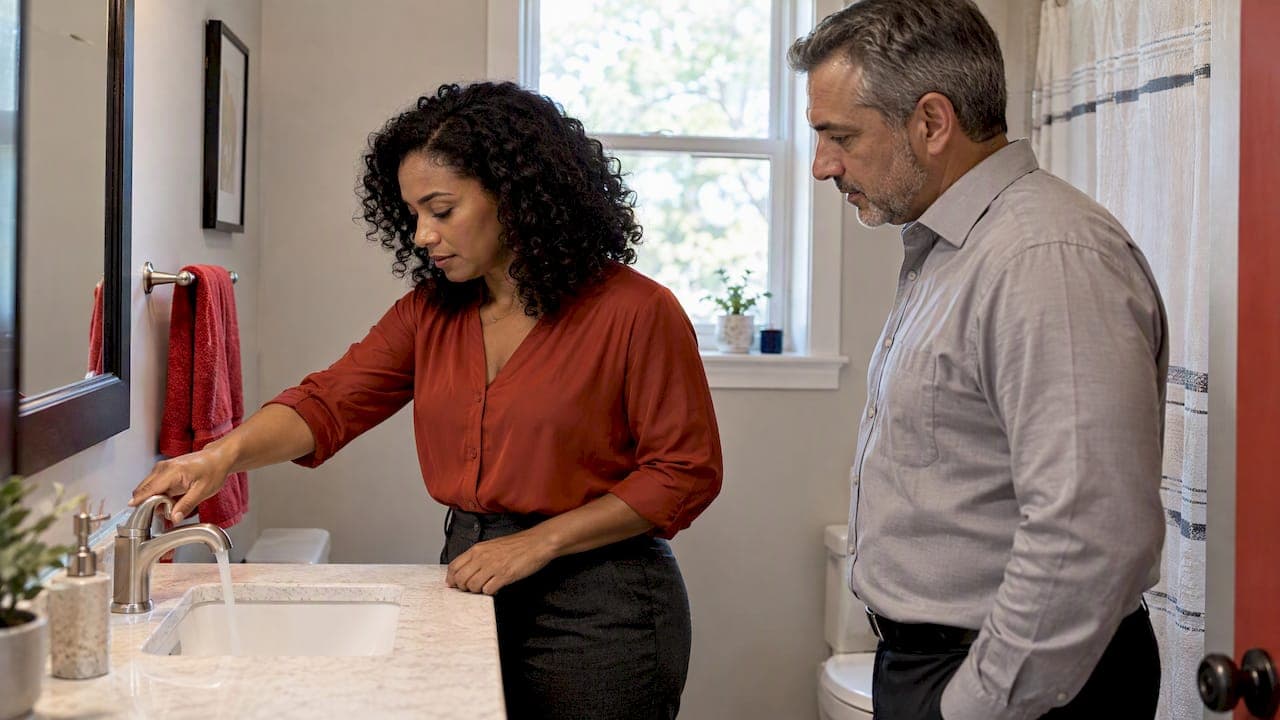
Your final walkthrough is a short visit, usually 24 hours or less before closing, to confirm the home is in the condition you agreed to buy. Use the checklist below to check repairs, included items, utilities and major systems, then report any problem to your agent and escrow officer before you sign. It is not a second home inspection, and it is your last practical chance to fix a problem before the home is yours.
I’m Mike Velez, broker-owner of BLDG Realty. I walk Chino Hills, Chino, Eastvale and Ontario buyers through this step, and I’ve seen a missing light fixture, a dead outlet and an unfinished repair surface on closing week. This guide covers what to bring, what to test room by room, and what to do when something is off.
TL;DR
- Schedule the walkthrough as close to closing as you can, ideally within 24 hours, and book enough time: about 15 minutes for a small home, an hour or more for a larger lot with a pool, shed or detached garage.
- Bring your inspection report, repair agreement, original listing photos and a phone charger, then test every outlet, faucet, appliance, window, door and the HVAC.
- Compare the home against the contract, not your memory. You are checking agreed repairs, included items and condition, not hunting for new wish-list items.
- If anything is wrong, tell your agent and the escrow officer right away, in writing, before you sign closing documents.
Table of Contents
- What the final walkthrough is (and isn’t)
- When to schedule it
- What to bring
- The room-by-room checklist
- Quick reference table
- What to do if something is wrong
- Don’t forget the money side of closing day
- Sellers: how to pass the walkthrough
- Our perspective: the walkthrough is where the deal gets kept
- Buying or moving up in Chino Hills, Chino, Eastvale or Ontario?
- FAQ
- Sources
What the final walkthrough is (and isn’t)
The walkthrough confirms that the property is in the expected condition before closing. NAR’s buyer checklist frames it as a check that requested repairs are complete, that included items are still there, and that utilities and major systems work.

It is not a new inspection. As a Texas real estate professional quoted by HAR puts it, the goal is to confirm the property is still in the agreed condition and that repairs were done. That distinction keeps you focused on what changed since your inspection and on what the seller promised.
In California, the standard purchase agreement generally gives the buyer the right to a final verification of the property’s condition shortly before close of escrow. It is not a contingency to cancel the sale over cosmetic preferences. Check your own contract for the exact window and wording, because it can be edited deal by deal. Your agent can point you to the paragraph.
It also sits inside escrow. NAR explains that the buyer does a final walkthrough to confirm agreed-upon condition before the deal closes and funds are released to the seller. Once the deed records, informal fixes get much harder.
When to schedule it
Book it as late as is practical. HAR advises doing the walkthrough within 24 hours before closing when possible, often the evening before.
A few timing rules we use with clients:
- Pick a time with daylight. You will see water stains, cracks and yard issues far better than at 7 p.m. in November.
- Leave real time. HAR suggests roughly 15 minutes for a small home and more than an hour for a bigger property or one with a pool, shed or detached garage. Many Chino Hills and Eastvale homes have a pool, spa, side yard or three-car garage, so plan for the longer end.
- Walk again after a major event. HAR notes that a significant storm, fire, earthquake or similar event justifies another visit, since new water intrusion or damage can change the property. In Southern California, a shake or a heavy rain week before closing is reason enough to ask.
- Do not do it the same minute you sign. If you find a problem at the closing table, you have little room to resolve it.
What to bring
Prepare like it matters, because it does. Realtor.com’s January 2026 guidance recommends the following, and I’d add a few items:
- Your inspection report and the signed repair request or addendum, so you can verify negotiated work instead of just noticing that something looks new.
- The original listing photos, to spot swapped fixtures, missing items or changed landscaping.
- A phone charger to test outlets.
- A screwdriver and a new set of locks for after closing.
- A printed copy of this checklist, a pen, and your phone for photos and video.
- Your purchase contract’s list of included and excluded items, such as the refrigerator, washer and dryer, window coverings, TV mounts and garage door openers.
Photos and video give you a dated record. If you find a discrepancy, you want to show it, not describe it.
The room-by-room checklist
Work in a set order so you don’t skip areas. Open every closet, cabinet and door. NAR’s checklist specifically covers every room, closet, attic, basement and crawl space, not just the main living areas.
Before you walk in: paperwork and agreed repairs
- Compare each repair on your addendum with the work done. Look for receipts, invoices, permits where relevant, and warranties from the contractor.
- Confirm the work is complete, not just patched. A fresh paint spot on a ceiling is a reason to ask what was repaired and where the receipt is.
- Ask the seller’s side for the paid bills and warranties for any repair work, per the NAR checklist.
Exterior and yard
- Walk the roofline, gutters and downspouts. Look for new damage, loose tiles or debris.
- Check the landscaping and irrigation. Plants, trees and lawn should be in the condition they were in when you wrote the offer. Run the sprinkler zones if you can.
- Test the garage door, the opener and every remote. Count the remotes.
- Look at the fences, gates, patio covers, side yards and any shed.
- If there is a pool or spa, check that equipment runs, the water is clear, and any agreed service was done.
- Look for items left behind: old paint cans, broken furniture, yard waste.
Entry, doors and windows
- Open and close every door and window. Make sure they latch and lock.
- Check screens and glass for cracks, missing screens or new damage.
- Test the doorbell and any exterior lights.
- Confirm you receive all keys, fobs, mailbox keys and gate or community access devices.
Kitchen and laundry
- Run the dishwasher briefly, turn on each burner and the oven, and test the microwave, range hood and disposal.
- Open the refrigerator and freezer. Check that it is cooling and still the same model as shown, if it is included.
- Run water at every sink. Check for slow drains and look under the sink for moisture or new stains.
- If the washer and dryer convey, run them. If they do not, check that the hookups are capped and usable.
- Check cabinets and countertops for chips, cracks and new damage.
Appliance swaps are a known issue. Alex E. Edwards, a principal broker quoted by Realtor.com, flagged them as a common practical problem, which is why the listing photos matter.
Bathrooms
- Flush every toilet and check that it refills and stops running.
- Run sinks, tubs and showers. Test hot water and water pressure.
- Check under vanities and around tubs and toilets for leaks, soft spots or stains.
- Run the exhaust fans.
- Look at caulk, grout and tile for new cracks or repair marks.
Living areas and bedrooms
- Test every light switch, ceiling fan and outlet. A charger plugged into each outlet is quick and reliable.
- Check walls and ceilings for new marks, holes, stains or fresh patches.
- Confirm that included window coverings, fixtures and fireplace items are present.
- Inspect the flooring. Look for scratches, gouges or damage from the move-out, especially at doorways and along hallways.
- Open every closet and look at shelving and doors.
Major systems and utilities
- Turn the HVAC on to both heat and cool. Confirm air comes from the vents and the thermostat responds. Even in October, test both modes.
- Check the water heater for leaks and run hot water.
- Open the electrical panel and check that breakers are labeled and nothing looks tampered with.
- Find the main water shutoff and the gas shutoff, and make sure you know where they are.
- Confirm smoke and carbon monoxide detectors are present and working.
Attic, garage and storage
- Look for debris, new stains on the ceiling, or evidence of pests.
- Check that the garage is empty of the seller’s belongings unless the contract says otherwise.
- Make sure any excluded items were removed and not replaced with something of lower quality.
Smell test
Nose first, then eyes. Courtney Klosterman of Hippo, quoted in a NAR survey piece on buyer’s remorse, says a fishy odor may point to an electrical problem, an unexplained ammonia smell may involve an appliance, and a damp or musty smell may signal moisture. Do not write odors off as cleaning products. Ask about them.
Quick reference table
| Area | What to test | Red flag |
|---|---|---|
| Repairs | Compare work to addendum, ask for receipts | Fresh patch, no paperwork |
| Included items | Appliances, fixtures, window coverings, remotes | Something missing or swapped |
| Plumbing | Every faucet, toilet, shower, disposal | Slow drain, low pressure, stains |
| Electrical | Every outlet, switch, fan, panel | Dead outlet, buzzing, burnt smell |
| HVAC | Heat and cool, vents, thermostat | No airflow, odd noises |
| Doors and windows | Open, close, lock | Won’t latch, cracked glass |
| Yard and exterior | Irrigation, garage door, fences, pool | Dead plants, damage, debris |
| Seller’s belongings | Rooms, garage, attic | Trash or items left behind |
If you want a printable format, InterNACHI’s checklist sorts each item into leave behind, remove, tested operational and previously unreported defect columns. That structure gives you a room-by-room record and cuts down on disputes over what conveys.
What to do if something is wrong
The worst move is to say nothing and sign anyway. Here is the order I follow with clients.
- Document it. Photos and video, with the room and date.
- Tell your agent immediately. They coordinate with the seller’s agent and the escrow officer. NAR’s list of agent duties includes accompanying the buyer on the walkthrough and coordinating with the closing agent.
- Put it in writing to escrow. A verbal promise at the front door is not an agreement.
- Choose the fix. Options include completing the repair before closing, a credit at closing, a holdback in escrow, or a short delay. Which one fits depends on the problem and your contract.
- Check the paperwork. If a credit was agreed, it should show up in your closing figures. The CFPB says lenders must give you the Closing Disclosure three business days before closing, and recommends verifying items like seller credits and cash to close. If a number does not match what you agreed, stop and ask the closing agent why before signing.
For serious issues such as active water intrusion, suspected structural damage or a missing major system, talk to your agent and, where needed, a real estate attorney about your options before you close. Do not rely on a general guide for that call.
Save small things for after closing. A scuffed baseboard is not usually worth delaying a deal. A broken water heater or an unfinished roof repair is.
Don’t forget the money side of closing day
The walkthrough covers the property. Closing day also covers money, and that deserves the same care. Review your closing figures early. A CFPB speech on electronic closings cited research that consumers who reviewed closing documents in advance fared better on understanding and efficiency. Treat the walkthrough the same way: prepare, don’t improvise.
For the financial side of the last 72 hours, including wire safety, this closing day checklist for buyers is a good companion to the walkthrough. If you are still working out your numbers, our homebuyer budget workbook walks through monthly caps and cash to close. And if your deal has a gap between appraisal and price, see how appraisal gap coverage can change your cash needs.
Sellers: how to pass the walkthrough
If you are selling, the same list works in reverse. A clean walkthrough often decides whether closing day is calm or tense.
- Finish every agreed repair and keep the receipts and warranties together in one folder.
- Leave the home broom-clean and empty, unless you agreed otherwise. Remove all debris, including from the garage and side yard.
- Leave every included item in place: fixtures, remotes, window coverings, manuals.
- Keep utilities on through closing so the buyer can test everything.
- Keep watering and maintaining the yard.
- If you are staying after closing, put the details in a written agreement. Our guide to rent back agreements covers what to include.
Sellers also want to know what the sale will net them. Our seller closing cost guide for California and the seller net sheet walkthrough show where the numbers come from.
Our perspective: the walkthrough is where the deal gets kept
Most walkthroughs are uneventful. That is the point. When a deal is run well, nothing at the walkthrough should surprise you, because the repair list was specific, the seller knew what was expected, and your agent confirmed progress along the way.
Here is how we handle it at BLDG Realty. We confirm repair status a few days before the visit, so you are not the first to learn that something is unfinished. We attend the walkthrough with you, bring your inspection and repair paperwork, and compare the home with the listing photos. If something is off, we contact the other side and escrow the same day, in writing.

One habit I’d push every buyer to adopt: treat the walkthrough like the end of a project, not the start of a negotiation. Buy with a written punch list. Walk it with a pen. Do not sign until each line is either checked or resolved.
Move-up families in Chino Hills and Eastvale also face a second layer. You may be closing on your new home the same week you hand over your old one. That is why we coordinate both sides, so your walkthrough on the purchase and the seller’s final check on your sale don’t collide.
— Mike Velez
Buying or moving up in Chino Hills, Chino, Eastvale or Ontario?
If you want a broker-owner at your side from offer to final walkthrough, take a look at our VIP Buyer Program. If you’re selling one home and buying another, our Move-Up/Down service coordinates both ends so you aren’t stuck between homes. Sellers can compare listing options on our sell options page.
FAQ
How long should a final walkthrough take?
Plan for about 15 minutes in a small home and more than an hour for a large property or one with a pool, shed or detached garage, according to HAR. Rushing is the main way problems get missed. Ask your agent to book a window long enough to test everything.
Can I back out of the purchase after the final walkthrough?
In California, the walkthrough is generally written as a verification, not a contingency, so you usually can’t cancel just because you dislike something. Material problems, such as unfinished agreed repairs or new damage, are different, and your options depend on your contract. Talk to your agent right away, and consult a real estate attorney for a serious dispute.
What if the seller hasn’t finished the repairs?
Document it, tell your agent and escrow in writing, and discuss options: finish before closing, a credit, a holdback or a short delay. Make sure any credit shows up correctly in your closing figures, which you can check against your Closing Disclosure.
Do I need my agent at the walkthrough?
It is strongly recommended. Agents typically schedule the walkthrough, accompany you, and coordinate with the lender and closing agent if something needs fixing. Having someone who knows your contract and repair list makes the visit faster and the follow-up cleaner.
What should I do if the walkthrough reveals a smell I can’t explain?
Don’t assume it’s cleaning products. A musty smell can mean moisture, and other odors can point to electrical or appliance trouble. Note where it’s strongest, take photos, and ask your agent to raise it with the seller before closing.
Sources
- Checklist: Your Final Walk-Through, NAR
- A Final Walk-Through Checklist for Homebuyers, Realtor.com
- 7 tips to ace your home’s final walk-through, HAR.com
- What Is an Escrow Account?, NAR
- Survey: Buyer’s Remorse Rooted in Surprise Property Issues, NAR
- Closing disclosure explainer, CFPB
- Prepared Remarks of CFPB Director Richard Cordray at the CFPB Forum on eClosings
- InterNACHI’s Final Walk-Through Checklist
- 179 Ways Agents Who Are REALTORS® Are Worth Every Penny, NAR