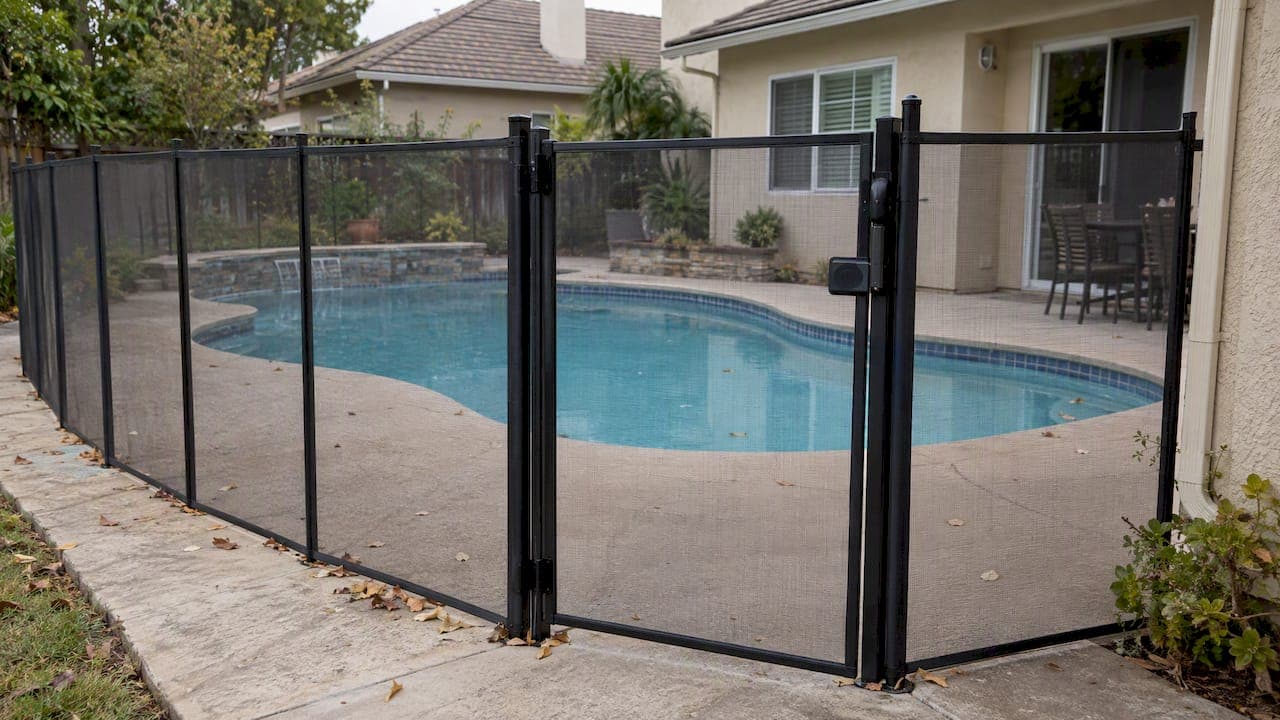
California law requires at least two of seven approved drowning-prevention features on every new or remodeled single-family home pool, under the Swimming Pool Safety Act. Enclosures must stand at least 60 inches tall, clear no more than 2 inches off the ground, and block a 4-inch sphere from passing through. Permits also trigger antientrapment drain upgrades. Confirm the specifics with your local building department before you build, remodel, or sell.
TL;DR:
- Choose two independent protections, such as an isolation fence plus a door alarm; duplicate alarms do not provide redundancy if a door stays propped open.
- Enclosures must stand 60 inches tall, allow at most 2 inches of ground clearance, and block any sphere four inches wide.
- Remodel permits can trigger drain upgrades: use balanced outlets three feet apart or an approved alternative, plus compliant grates removable only with tools.
- Local rules may exceed state standards, so ask your building department for written requirements before designing or pricing the project.
- Keep certification labels, permit receipts, and inspection records together; buyers may request them, and unresolved approval gaps can delay escrow or appear in title searches.
Table of Contents
- What the Swimming Pool Safety Act actually requires
- Exact fence and gate specs inspectors check
- The seven approved features and how to combine them
- Drain and suction outlet rules you can’t skip
- Permits, inspections, and what shows up at sale time
- Checking your city’s stricter local rules
- A pool-safety checklist for Chino Hills sellers and buyers
- What California pool law gets right, and where owners still trip up
- Getting your pool sale-ready with BLDG Realty
- FAQ
- Sources
What the Swimming Pool Safety Act actually requires
The Swimming Pool Safety Act applies when a building permit is issued for a new or remodeled pool at a private single-family home. It does not reach every pool statewide; public pools and several other property types fall outside its scope. Once a permit is pulled, the home must have at least two of these seven qualifying features:
- An isolation enclosure around the pool
- Removable mesh fencing meeting ASTM F2286
- A safety pool cover meeting ASTM F1346-23
- Exit alarms on doors leading to the pool area
- Self-closing, self-latching devices on those doors
- In-water pool alarms meeting ASTM F2208
- Another feature the building official finds equally protective
Local building officials inspect the installed features and sign off before final approval closes out the permit. Skipping that inspection, or assuming an older pool is grandfathered once you start remodeling, is one of the more common mistakes we see trip up a sale timeline.
Exact fence and gate specs inspectors check
The physical rules governing enclosures sit in Health and Safety Code §115923, and inspectors measure against them precisely:
- Minimum height of 60 inches from the ground
- No more than 2 inches of clearance between the bottom of the fence and the ground
- No gap large enough to pass a 4-inch sphere through, anywhere in the barrier
- Gates must swing away from the pool, close on their own, and latch on their own
Latch height and placement matter too. A self-latching mechanism set too low gives a toddler an easy reach, which defeats the purpose of the barrier. Inspectors also look for footholds or handholds on the outside face of the fence, since horizontal rails or decorative cutouts can turn a compliant-looking fence into a climbable one.
Pro Tip: Measure your existing fence’s ground clearance after any mulch, gravel, or soil regrading, since landscaping changes can quietly push a compliant fence out of code.
The seven approved features and how to combine them
Each of the seven features carries its own technical standard, and the law expects two of them to work as independent, redundant layers rather than two versions of the same protection.
- Isolation enclosure: a physical fence separating the pool from the house and yard access points.
- Removable mesh fencing: a see-through barrier meeting ASTM F2286, often used around existing pools where a permanent fence is impractical.
- Safety pool cover: a cover rated to ASTM F1346-23, strong enough to support weight and prevent accidental entry.
- Exit alarms: devices on doors leading to the pool area that sound when opened.
- Self-closing, self-latching devices: hardware that closes and secures doors automatically.
- In-water pool alarms: sensors meeting ASTM F2208 that detect disturbance in the water.
- Other equally protective means: an alternative a local building official formally accepts.
One figure worth remembering: the law sets the bar at two of seven features, not one, because a single layer still leaves a gap when it fails or gets left open. Pairing an isolation fence with an exit alarm, for example, gives you a physical barrier and a secondary alert if someone slips past it. Two door alarms on the same house, by contrast, don’t create that redundancy since both fail the moment a door is propped open.
Drain and suction outlet rules you can’t skip
Permit-triggered work doesn’t stop at fencing. Suction outlets also have to meet antientrapment standards, and the CSLB’s consumer guidance lays out what inspectors confirm before signing off.
- Dual hydraulically balanced suction outlets, separated by at least three feet, or an approved alternative like a skimmer or overflow system
- Grates compliant with the ANSI/APSP-16 performance standard
- Grates that can only be removed with tools, never by hand
Remodels on older pools commonly need these upgrades even when nothing else about the pool is changing. Planning for antientrapment work at the permit stage, rather than after an inspector flags it, saves a round of change orders and keeps your project on schedule.
Permits, inspections, and what shows up at sale time
A building permit for new construction or a remodel is what activates both the two-of-seven rule and the antientrapment drain requirements. Local building officials conduct the inspection and issue final approval; without it, the permit stays open and that gap can surface during a title search or escrow.
- Home inspectors note which of the seven features are present and flag it if fewer than two exist
- The CDPH’s drowning-prevention guidance points to a four-sided isolation fence as the most studied and effective barrier, ahead of a fence that only partially separates the pool
- Keep product labels, ASTM/ANSI certification tags, and permit receipts together in one folder
Pro Tip: Photograph certification labels on your cover, mesh fence, or alarm system before they weather or peel, since inspectors and buyers’ agents both ask for them.
Checking your city’s stricter local rules
Many California cities and counties layer additional requirements on top of the state minimums, whether that’s a taller fence, a specific gate placement, or extra equipment near spas. The state law is a floor, not a ceiling.
- Call your local building permit counter before you design or price a project
- Ask for the municipal code section in writing, not just a verbal summary
- Request copies of any permit handouts specific to pool construction
If the answer you get seems ambiguous or contradicts what a contractor tells you, ask the building official for a written interpretation. A licensed pool contractor who regularly pulls permits in your jurisdiction will usually know these local quirks already, which can save you a redesign later.
A pool-safety checklist for Chino Hills sellers and buyers
Selling a home with a pool in Chino Hills, Chino, Eastvale, or Ontario means addressing compliance before the listing goes live, not after an offer comes in.
- Sellers: confirm at least two qualifying features are installed, gather certification labels and permit records, and schedule any contractor work early so it doesn’t stall escrow
- Buyers: request the seller’s documentation, write a pool-safety contingency into your offer, and ask your inspector to specifically check antientrapment compliance and fence specs
Coordinating a contractor, a building inspector, and a closing timeline at once is exactly the kind of logistics an agent who works these neighborhoods daily can handle on your behalf, so the pool becomes a selling point instead of a delay.
What California pool law gets right, and where owners still trip up

The two-of-seven structure is smarter than a single blanket rule because it forces redundancy instead of a checkbox. Where the system falls short is awareness: most homeowners only learn the specifics when a permit, a sale, or an inspection forces the issue, which is backwards. The CDPH’s own research points to isolation fencing as the most effective single barrier, yet many owners treat a door alarm or a pool cover as “good enough” because it’s cheaper to add after the fact.
If you take one thing from this, prioritize the physical barrier first and treat the second feature as genuine backup, not a duplicate. A fence that fully separates the pool from the house, paired with an alarm or self-latching gate, covers you for both the letter of the law and the actual goal behind it: keeping a child who wanders outside unsupervised from reaching the water at all. Compliance on paper and real protection in your backyard should be the same thing, and too often they aren’t.
— Mike Velez
Getting your pool sale-ready with BLDG Realty
We coordinate with local inspectors and contractors to help ensure pool compliance does not delay a sale. We assist with gathering certification labels, permit receipts, and inspection records that buyers and their agents may request.

- We help sellers line up contractor work before a listing goes live through our listing packages
- We help buyers write pool-safety contingencies and coordinate inspections through our VIP Buyer Program
- We can assess your property for sale-readiness before you list.
If your home has a pool and you’re weighing a sale in the next few months, reach out through our Chino Hills listing page and we’ll map out exactly what needs attention before buyers ever see it.
FAQ
What are the new pool laws in California starting in 2026?
The core requirement, at least two of seven approved drowning-prevention features for new or remodeled single-family home pools, comes from the existing Swimming Pool Safety Act and has not changed. Recent legislative action, including SB-552, has focused on clarifying enforcement and inspection roles rather than adding new technical standards. Check with your local building department for any jurisdiction-specific updates before starting a project.
Is it illegal to have a pool without a fence in California?
A fence isn’t the only path to compliance since the law accepts any two of seven approved features, which could include a safety cover and an exit alarm instead of fencing. That said, state guidance from the CDPH identifies a four-sided isolation fence as the most effective single barrier available. Many local jurisdictions also require fencing specifically, so check your city’s code before assuming an alternative will satisfy local inspectors.
Do pools have to be fenced in the USA?
Pool safety rules vary by state, and there’s no single nationwide fencing mandate. In California, a fence is one of seven qualifying options under the Swimming Pool Safety Act, not a standalone requirement, though it’s the most commonly used and most studied option.
What should I check before deciding my pool is adequately protected for visiting children?
Count your existing safety features against the list of seven approved options and confirm you have at least two working independently of each other. Review fence height, gate self-latching function, and cover certification labels, and consult your local building department if you’re unsure whether your setup meets both state and local requirements.
Sources
- ARTICLE 2.5. The Swimming Pool Safety Act 115920 - 115929 — California Legislative Information
- CSLB — Swimming pool construction: consumer guidance
- California Department of Public Health — Drowning prevention: toddler pool and spa safety