Open houses still work, but only when you treat them as a lead-generation campaign rather than a single Saturday event. The highest-impact approach is simple: prepare the home thoroughly, capture every visitor’s contact information digitally with a qualifying question, and follow up within 24 hours. Expect steady buyer leads and neighborhood referrals more often than an instant sale, and plan your week around that outcome.
TL;DR:
- Using digital sign-ins with qualifying questions captures better leads and enables targeted follow-up within 24 hours, increasing conversion chances.
- Proper seller preparation, including staging, decluttering, and curb appeal, significantly improves property presentation and potential offers.
- Building momentum through pre-event marketing—professional photos, social ads, neighborhood invitations—boosts turnout rather than relying on last-minute efforts.
- Daily on-site safety protocols, early arrival, and staffing with multiple agents reduce theft risks and keep the open house running smoothly.
- Treat each open house as a campaign, measuring key metrics like sign-ins, contact validity, and appointments to optimize future results and maximize return on investment.
Table of Contents
- Pre-event timeline and seller preparation checklist
- Marketing and promotion: where to drive traffic before the weekend
- On-the-day execution: greeting, visitor flow, hospitality, and safety
- Lead capture and follow-up plan that converts open-house visitors
- Measure success: metrics, ROI, and running open houses as a repeatable campaign
- Broker-owner perspective and practical examples from BLDG Realty
- BLDG Realty services that support a done-for-you open-house campaign
- FAQ
- Sources
Pre-event timeline and seller preparation checklist
A successful open house starts two weeks out, not the morning of. Build the timeline backward from the event date so staging, repairs, and marketing line up instead of colliding.

Two weeks before: schedule professional photos, book any staging furniture, and start minor repairs (loose doorknobs, scuffed trim, burnt-out bulbs). One week before: deep clean, depersonalize closets and counters, and confirm your marketing push is live. Day before: final walkthrough, fresh flowers or neutral scents, and a test run of your digital sign-in setup.
Room-by-room, prioritize the spaces buyers judge fastest:
- Declutter kitchen counters and stage a simple centerpiece on the dining table.
- Remove family photos and personal items from bedrooms and bathrooms.
- Open blinds and curtains to maximize natural light in main living areas.
- Clear closets to roughly half-full so storage looks generous.
- Replace any mismatched hardware or outdated light fixtures if the budget allows.
Curb appeal matters before a buyer ever reaches the door. Mow the lawn, clear the driveway for easy parking, sweep the walkway, and add a new doormat or potted plants near the entrance. Staging and decluttering done well often help a property present faster and draw stronger offers, according to practical seller preparation guidance.
Sellers also carry responsibilities beyond aesthetics. Secure or remove valuables, medications, and personal documents before the first visitor arrives, and confirm with your agent which disclosures must be posted or available on-site, since agency relationships and required disclosures vary by state and need documentation under continuing-education safety guidance.
Marketing and promotion: where to drive traffic before the weekend
Turnout is built in the five days before the open house, not the morning of. Sequence your channels so momentum builds toward Saturday instead of peaking too early.
- Book professional photography and a short video walkthrough at least a week ahead, then cut a 15-second teaser for social media.
- Refresh the MLS and portal listings two to three days before the event so the open house date surfaces in portal alerts and saved searches.
- Launch a targeted social ad to the surrounding zip codes 48 to 72 hours out, since local reach tends to convert better than broad geographic targeting.
- Place directional signage the morning of the event at major turns leading to the property, and confirm placement complies with local sign ordinances.
- Mail or hand-deliver neighborhood invitations with a QR code linking to the listing, giving nearby homeowners an easy reason to stop by.
- Boost the best-performing social post 24 hours before the event if early engagement (shares, comments, saves) suggests real interest.
Comparable listing photos and floor plans remain some of the assets buyers rely on most when deciding whether a property is worth visiting, based on buyer-behavior research from the 2025 Profile of Home Buyers and Sellers. If you need fast, polished visuals without hiring a full production crew, Blistr’s marketing collateral tools can generate floor plans, listing photos, and short videos from a single property capture.
Measure sign-up lift by comparing portal saves and ad engagement against the number of actual sign-ins at the door. A gap between online interest and in-person turnout usually points to weak signage or a listing description that undersells the property.
On-the-day execution: greeting, visitor flow, hospitality, and safety
Run the first hour as a neighbors-only preview. Invite nearby homeowners by name through your mailed flyers, hand them neighborhood comps as a takeaway, and treat them as future listing prospects rather than just curious visitors, since neighbors often convert into referrals or future sellers more reliably than anonymous foot traffic according to Inman’s reporting on repeatable open-house lead systems.
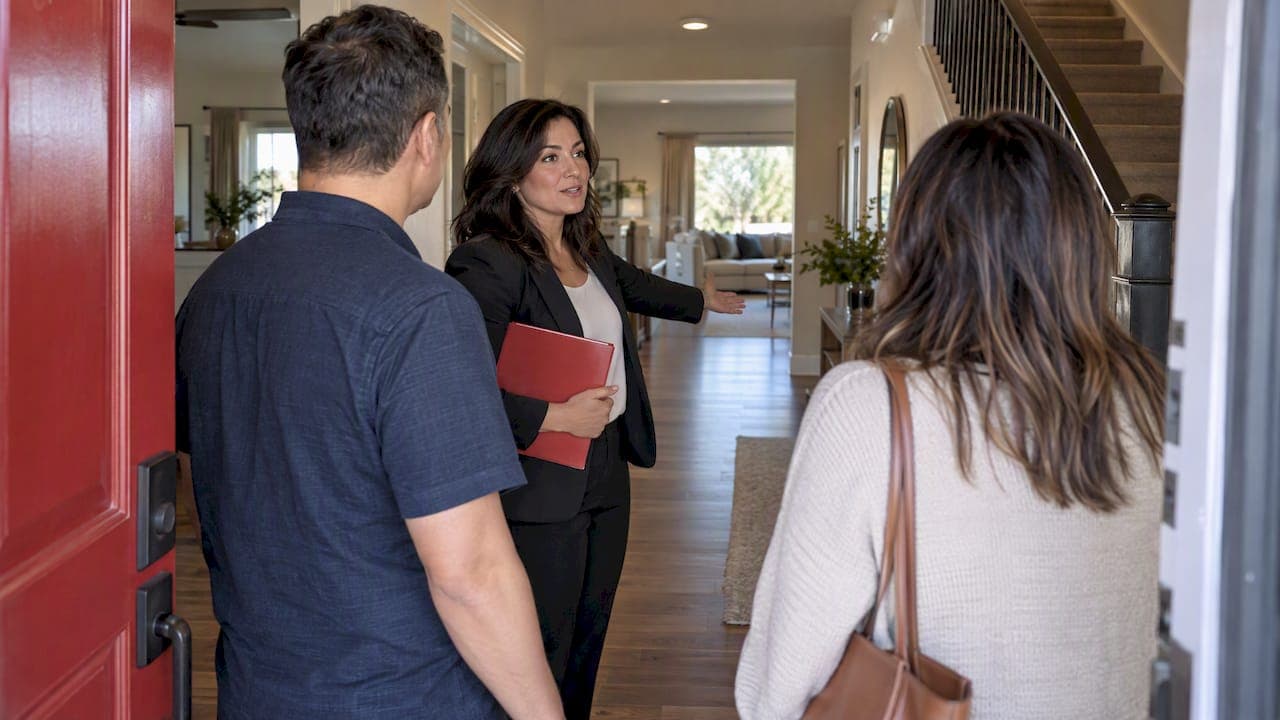
Greet every visitor at the door with a simple script: welcome them, ask them to sign in, then ask, “Do you live in the neighborhood, or are you looking to buy nearby?” That single question qualifies the lead in seconds and tells you whether to pitch a tour, a listing appraisal, or just a friendly conversation.
Control movement with a single entrance and exit, and place refreshments near the farthest point from the door so visitors walk through the entire home before they can leave. A few operational basics keep the day running smoothly:
- Arrive 30 to 45 minutes early to stage final details and test the sign-in tablet.
- Bring a second agent or assistant for busier listings so no one works the door alone.
- Avoid discussing seller motivation, listing strategy, or other offers with visitors.
- Walk every room before locking up to confirm nothing was left open, on, or missing.
Pro Tip: Text a colleague when you arrive and again when you leave, since the end of the event is the moment you’re most exposed if something goes wrong.
Advance registration, a second agent on-site, and a documented exit routine reduce the risk of theft or property damage while still keeping the home welcoming, per Florida Realtors’ open house safety guidance.
Lead capture and follow-up plan that converts open-house visitors
A sign-in sheet without a qualifying question is wasted paper. Build a digital form that captures name, phone, email, and one dropdown: “Just browsing,” “Looking in the next 6 months,” “Ready to buy now,” or “I live nearby.” That single field tells your CRM exactly how to route the lead.
- Hot leads (“ready now”): assign a same-day phone call task.
- Warm leads (“6 months”): assign a drip email sequence and a 30-day check-in.
- Neighbor leads: assign a home-value email and a quarterly check-in.
Automate the first three touches so nothing depends on memory:
- Within one hour, send a text thanking the visitor for stopping by and offering to answer questions.
- Within four hours, send an email with three comparable listings or recent neighborhood sales.
- By day two, send a segmented message matched to their dropdown answer, whether that’s a buyer consultation offer or a home-value estimate for neighbors.
Open houses remain an effective marketing tool for exposure and face-to-face connection, and that value compounds when digital sign-ins and automated follow-up are paired with a simple qualifying question at the door, according to the National Association of Realtors.
Keep your outreach short and specific. A hot-lead text might read: “Thanks for stopping by today. I’d love to set up a private tour this week, what day works best?” Track every call, email open, and reply inside your CRM so you can see which script and which segment actually book appointments, not just which ones get opened.

Measure success: metrics, ROI, and running open houses as a repeatable campaign
Judge each open house on four numbers: total sign-ins, the percentage with valid contact info, appointments set within a week, and conversions to a listing agreement or buyer offer. Without that data, you’re guessing whether the event worked.
- Calculate cost per sign-in by dividing total marketing spend by verified sign-ins.
- Calculate pipeline value by multiplying appointments set by your average commission on closed deals.
- Run the same listing’s open house weekly for two to three weekends in a farming neighborhood before judging results, since name recognition builds over repeat exposure.
- Test one variable per weekend, like swapping the sign-in incentive or the directional signage route, so you know what moved the needle.
Treating each open house as a repeatable campaign rather than a one-off event is what produces a growing pipeline over time, a pattern documented in Inman’s open-house lead system. Share a simple one-page report with sellers after each event: sign-ins, feedback themes, and next steps.
Broker-owner perspective and practical examples from BLDG Realty
Most agents run an open house to fill a Saturday. We run it as the first data point in a campaign. We treat neighbor engagement as a priority channel, not an afterthought, because a neighbor who shows up today often becomes a listing call in six months.
Owner-level involvement means the person who built the marketing plan is involved in greeting visitors, reading body language, and adjusting the follow-up sequence promptly. That continuity, from strategy to execution to the next-day phone call, is what separates a campaign from an event.
— Mike Velez
BLDG Realty services that support a done-for-you open-house campaign
If running this entire playbook sounds like a lot to manage on top of your own schedule, we built our services to carry the load. Our Demand Blueprint engineers buyer competition and neighbor engagement into every open house we run, aiming for multiple offers in a short window. Sellers who want full marketing at a lower cost can choose our Equity Advantage Listing, a flat-fee option that leaves more equity in your pocket.

When you hire us for an open-house campaign, you get professional staging guidance, cinematic photography and video, targeted social promotion, a digital sign-in and follow-up system, and personal greeting at the door. If a rapid timeline matters most, our 14-Day Sale Guarantee backs that priority in writing. Ready to see which service fits your goals? Explore our seller options and start your campaign.
FAQ
What is the 3-3-3 rule in real estate?
The 3-3-3 rule is a general buyer-readiness guideline: spend roughly three weeks researching neighborhoods and lenders, three days actively touring homes, and three hours deciding on an offer once you find the right one. It’s a rule of thumb rather than a formal industry standard, and timelines vary by market and buyer.
Is selling your home to Opendoor worth it?
Selling to an instant-offer company like Opendoor trades speed and certainty for a lower sale price compared to listing on the open market, since these companies typically buy below market value to account for resale risk and fees. Whether it’s worth it depends on how much you value speed versus maximizing your final sale price.
How much does a realtor make off of a $300,000 house?
Realtor commission is negotiable and varies by brokerage, service tier, and local market, so there’s no fixed national rate. Sellers can also choose flat-fee or reduced-commission listing options, which change the total payout regardless of sale price.
What are some tips for a successful open house?
Stage the home room by room, promote it through MLS refreshes, social ads, and neighborhood invites, and capture every visitor’s contact information with a digital sign-in form. Follow up within 24 hours using a segmented outreach sequence, since quick, qualified follow-up is what actually turns visitors into appointments.
Sources
- Open houses | National Association of Realtors®
- Open house safety starts before buyers arrive | Florida Realtors
- 2025 Profile of Home Buyers and Sellers
- The step-by-step open-house lead system that fills your pipeline | Inman