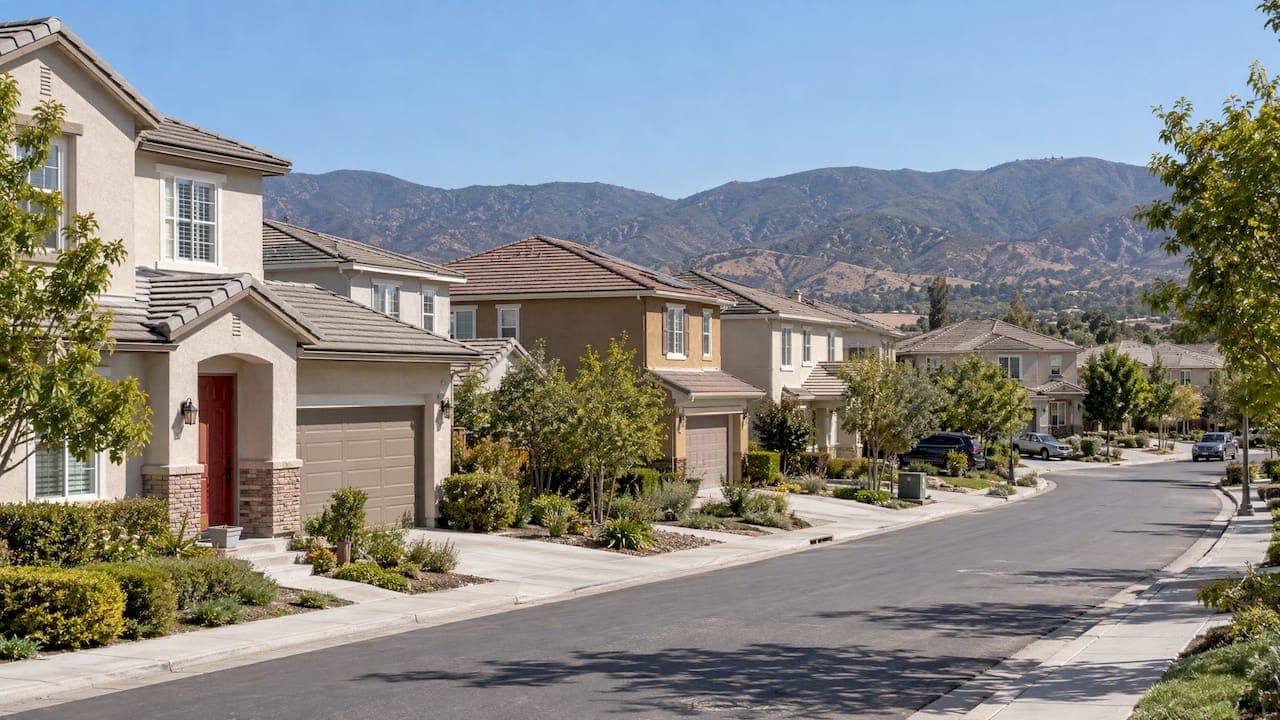
The forecasts for the Inland Empire called 2026 a flat-to-modest year: small price gains, slightly more sales, and mortgage rates easing. Actual rates have run higher than hoped, so the year has played out as a slow, selective market rather than a boom or a crash. Prices in Chino Hills, Ontario and Eastvale sit at very different levels, so a regional forecast only helps once you translate it to your own city and your own move.
I’m Mike Velez, and I’ve worked this market for over 30 years. Below is what the forecasters projected, what local sales data shows now, and how I’d use both if you are deciding to sell, buy or move up.
TL;DR
- Forecasters expected modest 2026 growth: the Riverside County base case was 2% to 5% value growth, and C.A.R. projected a 3.6% statewide median price rise.
- Mortgage rates were forecast to average 6.0% in 2026, but 30-year fixed rates in California were reported at 6.63% in July, so affordability stayed tight.
- Local prices differ widely: Chino Hills and Eastvale sit in the high $800,000s to $1 million range, while Ontario’s median is far lower.
- Waiting for a perfect market rarely beats pricing and marketing a home correctly now. Demand is selective, and well-presented homes still draw competing offers.
- Move-up sellers should line up the sale and the purchase together, so timing risk is managed instead of guessed.
Table of Contents
- What the 2026 forecasts projected
- How the year has actually played out
- Chino Hills, Ontario and Eastvale compared
- Should you act now or wait for 2027?
- Move-up sellers: where timing matters most
- Perspective: why I plan around demand, not forecasts
- What it costs to sell here
- Ready to plan your move?
- FAQ
- Sources
What the 2026 forecasts projected
Three forecasts shape most of the conversation, and they agree more than they differ.
Statewide (C.A.R.). In its September 2025 outlook, the California Association of Realtors projected 274,400 existing single-family home sales in 2026, up 2% from 2025. It also projected a record statewide median price of $905,000, up 3.6%, and mortgage rates easing to an average of 6.0% from 6.6% in 2025.

Riverside County. A December 2025 county report laid out three scenarios. The base case expected home values to grow 2% to 5% in 2026. The same report says the outcome depends on the mortgage-rate path, and that the “hunkering down” effect, where owners stay put because of low fixed rates, will keep fading.
What this means for you. No serious forecast predicted a crash or a spike. The range was narrow: a few percent of price movement, driven mostly by rates. For a $1 million home, 2% to 5% is roughly $20,000 to $50,000 over a year. That is meaningful, but it is smaller than the gap between a well-priced listing and a poorly priced one.
How the year has actually played out
Forecasts are assumptions. Here is what has happened against them.
Rates came in higher. C.A.R. assumed a 6.0% average, yet California 30-year fixed rates were reported at 6.63% in July 2026, above earlier 2026 forecasts.
Statewide prices cooled from a record. The same report notes the California median fell to $904,640 in June, a 2.8% drop from the record set in May. That is a normal seasonal pullback after a spring peak, not a sign of a broken market.
Headwinds were named in advance. C.A.R.'s chief economist, Jordan Levine, pointed to the home insurance crisis, trade tensions and possible stock market instability as mounting headwinds for 2026, even as lending conditions improved. Insurance cost is something every Chino Hills buyer should price in before making an offer, because it changes the real monthly payment.
Lock-in is easing, slowly. Roughly 77% of California homeowners hold mortgage rates below 5%, which has kept inventory tight for three years. Life events, such as growing families, job changes and retirement, are gradually pushing more of those owners to sell anyway. That is the move-up window many of my clients are watching.
Chino Hills, Ontario and Eastvale compared
The regional forecast hides large differences between these three cities. A buyer in Ontario and a buyer in Chino Hills are shopping in different price tiers.
| City | Recent median (source and period) | What it tells you |
|---|---|---|
| Chino Hills | About $1,120,000 on our Chino Hills community page | Premium suburban market, strong school attendance areas, higher-priced move-up inventory |
| Eastvale | $877,500 median sold price, six months to August 2026 | Newer homes, wide spread: the middle half of sales closed between $630,000 and $1,000,000 |
| Ontario | $645,936 median sold price, six months to October 2026 | More attainable entry point, with the middle half of sales between $545,000 and $755,000 |
Medians blend condos, townhomes and large single-family homes, so use them as a compass, not a price tag. A four-bedroom in a Chino Hills tract with a view and a three-bedroom townhome in Ontario share a headline number only on paper.
Chino Hills
Chino Hills is a high-barrier market. Affordability is the main constraint on how fast prices can climb, because many local households already stretch to buy here. That keeps price growth modest, but it also keeps demand steady from families who want the schools and the neighborhoods. Homes that are priced to the neighborhood and shown well still move. Homes priced to last year’s peak sit.
Eastvale and Ontario Ranch
Buyers comparing new construction in Eastvale and Ontario Ranch with resale homes in Chino Hills and Chino are usually weighing three things: price per square foot, lot size, and fees that come with newer communities, such as HOA dues and special assessments. Builders can offer rate buydowns that resale sellers cannot match on paper. The counter is that a well-located resale home often has a larger lot, mature landscaping and no construction wait. If you are a seller of a newer Eastvale home, expect buyers to compare your price with builder incentives, and price with that in mind.
Ontario
Ontario’s lower median makes it the natural first-time buyer market in this group. Down payment assistance, FHA-style loans and smaller down payments matter more here, so buyers’ financing is often the deciding factor in whether a deal closes. Sellers there do best when they present a clean, move-in-ready home and are flexible on timing.
Should you act now or wait for 2027?
This is the question behind most searches for a housing forecast. My answer: decide based on your life and your numbers, not on a rate prediction.
Waiting for lower rates is a bet. If rates fall, more buyers return and competition rises, which pushes prices up. You may get a lower payment and a higher price at the same time. Nobody, including the forecasters, has called rates reliably.
What you can control. Your price, your preparation, your marketing and your timeline. A seller who prices correctly in the first two weeks usually nets more than one who tests a high price and cuts it later, because buyers read a long listing history as a signal.
A simple way to decide:
- Write down the monthly payment you can carry on your next home at today’s rates. If it works at 6.5%, a drop in rates is a bonus, not a requirement.
- Estimate your home’s current value from recent comparable sales on your own street, not a citywide median.
- Decide your hard deadline: school year, job, lease, retirement. Work backward from it.
- If the deadline is within 12 months, start preparing now. Preparation takes 3 to 6 weeks before you list.
- If it is further out, set a review point every quarter and track sales near you.
Sellers: prepare before you list
Small fixes tend to pay back. Fresh paint, landscaping, and a thorough clean make photos and tours stronger. Many sellers book real estate cleaning services for carpets and upholstery before the photographer arrives, because stains and odors are the first thing a buyer remembers.

Buyers: shop the payment, not the price
Get a preapproval, then price insurance and property taxes into the monthly figure. Rate buydowns and seller credits can move your payment more than a small price cut can. The VIP Buyer Program is how we give buyers early access to curated MLS and off-market inventory so you see homes before they become open-house crowds.
Move-up sellers: where timing matters most
If you have outgrown a starter home and want to stay in Chino Hills, Chino, Eastvale or Ontario, the forecast matters less than the sequence. The risk is the gap: selling first and having nowhere to go, or buying first and carrying two mortgages.
There are three common ways to manage it, and the right one depends on your equity and your lender:
- Sell first with a flexible closing. Negotiate a rent-back or extended close so you can shop with a firm sale in hand.
- Buy with a contingent offer. Possible, but weaker in a competitive bid, so it suits slower segments.
- Bridge financing or a home equity line. Lets you use current equity as the down payment. Talk to your lender about cost.
I covered how to plan the sequence in our move-up strategy guide, and the principle holds: line up both sides of the move before you list.
Perspective: why I plan around demand, not forecasts
Forecasts tell you where the market might drift. They do not tell you what your house will sell for. I have watched homes sit at the same asking price in the same neighborhood, one drawing five offers and the other drawing none, and the difference was almost never the forecast.
That is why we built the Demand Blueprint. We engineer buyer demand before and during the first days on the market: cinematic media, drone and 3D tours, MLS and portal syndication, targeted broker and paid social reach, and AI-optimized listing copy. The aim is competing offers early, when buyer attention is highest.
I personally run every deal. You do not get handed to a junior agent, and you get one person accountable for pricing, marketing and negotiation. If you want a plan around a move-up, we coordinate the sale and the purchase together so you are not stuck in between.
Whatever the market does in 2027, the sellers who do best are the ones who prepare well, price accurately and create demand fast.
Mike Velez
What it costs to sell here
In a market where prices move a few percent a year, fees matter. At 5% to 6%, a $1,000,000 sale costs $50,000 to $60,000 in commission before any negotiation. Our published options are structured differently:
| Option | Published price |
|---|---|
| Demand Blueprint | 2.5% |
| Flat Fee Listing / Essentials | $9,500 one-off |
| Full Service | $12,500 one-off |
| Full Service + Media Plus | $15,800 one-off |
The Equity Advantage Listing is our lower-fee option that leaves more of the sale price with you. Details of what each tier includes are on the sell options page.
Ready to plan your move?
If you want a number for your own home and a plan sized to your timeline, we start with a conversation about your goals and a pricing review based on recent sales on your street. Sellers who need certainty can look at our 14-Day Sale Guarantee, which is our written promise of an acceptable offer within two weeks or you get paid. Read the terms on that page before you decide. To see how we handle a sale and a purchase together, start at BLDG Realty.

Buyers can browse current Chino Hills listings or read the guides in our Inland Empire resource library.
FAQ
Are home prices increasing in California?
Modestly, and unevenly. C.A.R. projected a 3.6% rise in the 2026 statewide median, but the median dipped 2.8% from its May record to June as the seasonal peak passed. Local results depend on the city, the price tier and the condition of the home.
Is it better to buy a house in 2026 or 2027?
It depends on your payment, your savings and your deadline, not on a prediction. If rates fall, prices and competition will likely rise too. If the payment works today and you plan to stay for years, buying now and refinancing later if rates drop is a common plan, which you should discuss with your lender.
How does the Chino Hills market compare to Ontario and Eastvale?
Chino Hills sits at the top of the three, with a median around $1.1 million on our community page. Eastvale’s recent median sold price was $877,500 and Ontario’s $645,936 over their reported six-month windows. Each has a different buyer, so compare homes on your own street, not city averages.
What is the 3-3-3 rule in real estate?
It is an informal rule of thumb with several versions, not a law or industry standard, so ask whoever quotes it what they mean. I would rather build your plan on three practical numbers: your monthly payment, your cash to close, and your move-by date.
Sources
- C.A.R. releases its 2026 California Housing Market Forecast
- Riverside County Housing Report: A 2026 Forecast
- CA home prices, mortgage rate: What buyers can expect (Sacramento Bee)
- What New MLOs Need to Know About California’s 2026 Housing Market
- Eastvale, CA Housing Market 2026
- Ontario, CA Housing Market 2026
- Real estate cleaning services